Software Copyright's Total Ban on AI: A Policy Out of Touch with Reality Is Forcing Developers to Lie En Masse
Critiques the Copyright Center's requirement for software copyright applicants to pledge no AI usage as disconnected from industry reality, analyzing its impact on one-person companies, malicious reporting, and the pressure it puts on developers to collectively lie.
Recently, the China Copyright Protection Center released a notice titled “Jointly Maintaining a Healthy Ecosystem for Computer Software Copyright Registration.”
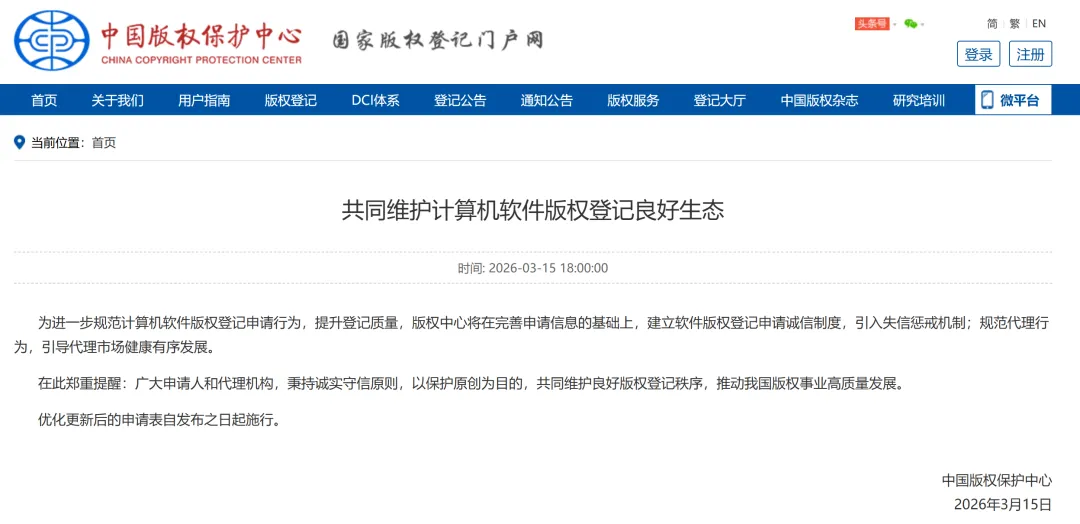
The notice states that to further standardize software copyright registration applications and improve registration quality, the Center will update the application form and introduce a失信惩戒机制 (credit punishment mechanism).
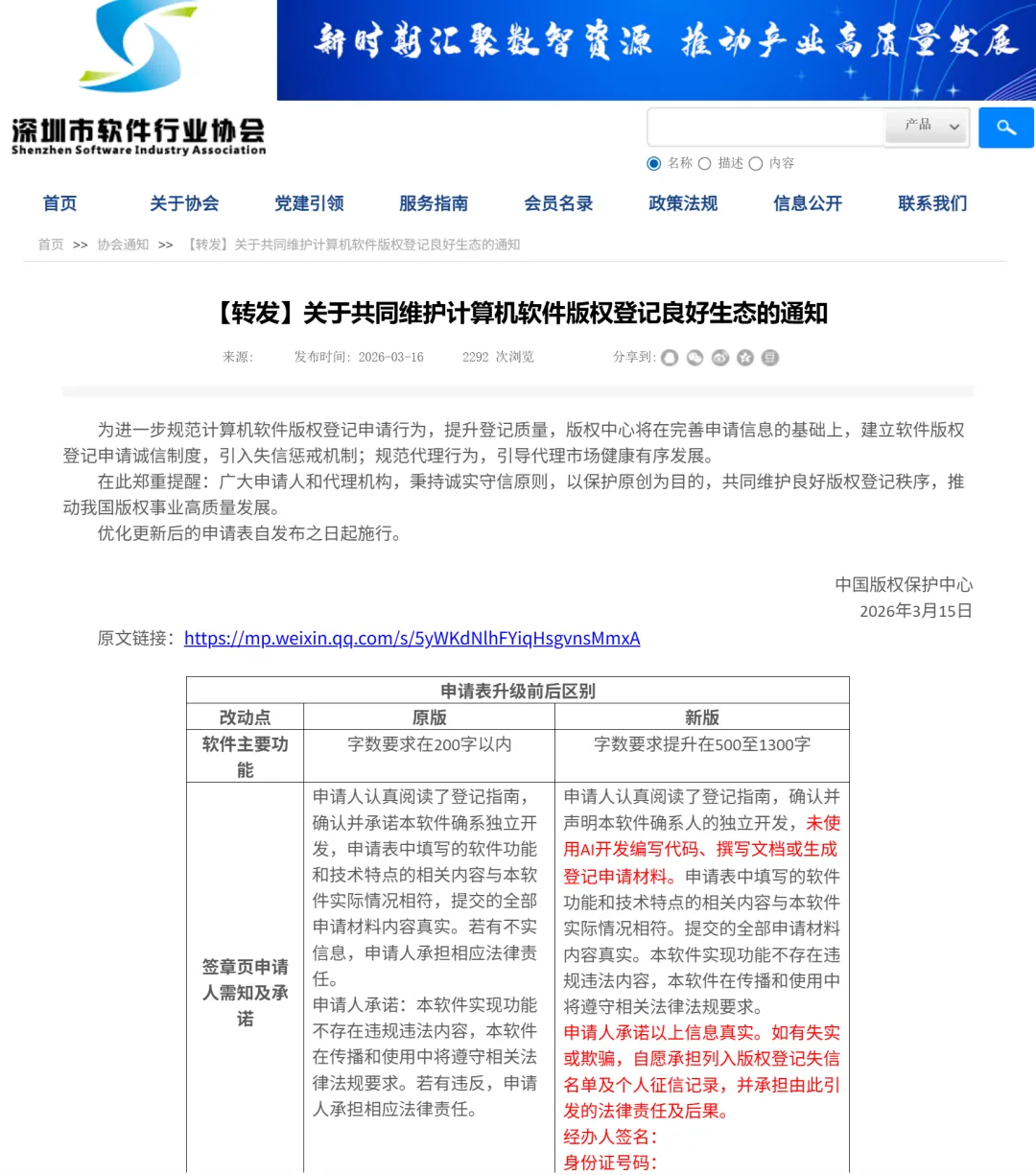
Comparing the old and new application forms, two main changes stand out:
One is that the product description word count has increased from 200 characters to 500-1000 characters.
The other—and the most controversial—is that applicants must now make a clear pledge:
“No AI was used to develop, write code, write documentation, or generate registration application materials.”
Otherwise, they will
“voluntarily accept inclusion in the copyright registration dishonesty list and personal credit record, and bear the resulting legal liabilities and consequences.”
Seriously—will any software still be eligible for registration after this?
* This article reflects only the author’s personal views and is not intended as legal advice.
1. AI-Assisted Coding Is Now an Absolute Industry Standard
With technological progress, AI participation—or even leadership—in code writing has long become the absolute norm in software development.
Programmers widely use various intelligent assistant tools to improve efficiency.
Years ago, mainstream IDEs almost all built in code prediction and autocomplete features.
And today’s development ecosystem is even more aggressive.
Numerous specialized AI editors have emerged, such as Cursor, TRAE, Google Antigravity, etc., all centered on powerful AI assistance capabilities.
And now there’s Vibe Coding, where AI automatically analyzes intent, reads context, and even creates and writes individual code files.
At least as of 2026, AI is deeply embedded in every aspect of software engineering.
This raises an extremely real question.
Setting aside Vibe Coding—if a developer uses an IDE’s built-in code completion, does that violate the “no AI used to write code” pledge?
Going further: if a developer encounters an error during development, feeds the error log to a large language model, and adopts the AI’s suggested fix—how is that defined?
If interpreted literally, the vast majority of modern software would lose its eligibility for software copyright registration.
Requiring developers to completely abandon AI tools and hand-type every line of code is completely out of step with current technological development.
In today’s fast-iterating engineering environment, it’s nearly impossible to find a modern software project without any trace of AI assistance.
2. The Compliance Dead End for One-Person Companies
This new regulation is particularly devastating for “one-person companies” and independent developers.
One-person companies are the current trend.
In the past two years, the independent developer community has grown rapidly. The biggest driver behind this “solo combat” capability is AI technology.
With the proliferation of AI, frontend, backend, and art resources can now be fully AI-generated.
A backend programmer who doesn’t know frontend can use AI to create smooth interactive UIs.
A product manager with just ideas can use AI to turn concepts directly into runnable programs.
More and more individual entrepreneurs can complete the product closed loop independently.
Some cities have even begun actively promoting preferential policies for “one-person AI companies,” with targeted subsidies for AI usage such as computing power purchases and external AI services.
In these micro or one-person teams, from underlying code architecture to daily workflows, AI has already substantively assumed the role of a key developer.
AI is not just a tool—it’s the foundational productivity they rely on to survive.
The Copyright Center’s absolute restriction like this effectively cuts off the copyright protection path for one-person (AI) companies at the compliance level.
The Dilemma of Credit Risk
Even more concerning is the accompanying severe punishment mechanism.
The pledge explicitly ties violations to personal credit records.
This forces many startup teams into a corner.
Developers now face an extremely harsh choice:
Either completely give up applying for software copyright, leaving their work unprotected—and facing difficulties when publishing on app stores or during financing due diligence.
Or grit their teeth and submit the application, signing a pledge they can’t absolutely guarantee—living in constant fear of being placed on dishonesty (失信) lists or blacklisted on their credit report.
This binary policy direction runs counter to the current trend of encouraging individual innovation and developing one-person companies.
Fueling a Malicious Reporting “Industry”
This policy also very easily breeds a gray industry of malicious reporting.
In the absence of clear definition standards, this ban could become a deadly weapon for attacking competitors.
“They did better than me? Report them. They just bought a quantity promotion? Report them.”
Currently, no one’s code truly hasn’t used “autocomplete”—one report and you’re caught.
Whose code doesn’t have some trace of AI autocomplete?
Competitors get jealous and file a report. The accused would find it extremely difficult to produce definitive proof that every line of code was hand-typed.
This will seriously corrupt industry culture and make developers paranoid.
3. The Gap Between Policy Intent and Objective Reality
“One-size-fits-all” is unreasonable.
We can guess the Copyright Center’s “intent” behind this policy.
In the past two years, barrier to AI tools has dropped significantly, especially after excellent AI coding agents like Claude Code and CodeX emerged.
(Incidentally, Claude Code was “forcedly open-sourced” on March 30, so related agents will inevitably explode.)
Besides normally produced software, there will certainly be numerous attempts to use AI to automatically generate meaningless code and documentation for batch-applying for copyright registration to monopolize software copyright names.
These worthless materials flooding into the Copyright Centerinevitably impose an enormous workload on the review department.
Cracking down on using AI to generate junk applications and fraudulently obtain registrations is unobjectionable.
But one-size-fits-all denial of AI’s legitimacy in all software development is throwing the baby out with the bathwater.
Forcing Widespread Non-Compliance
A well-designed policy must be based on objective reality.
When policy standards are too high or disconnected from reality, it very easily causes “widespread non-compliance” within the industry.
In China, software copyright registration occupies a uniquely critical position.
It’s a prerequisite for app store publishing, a precondition for game license (版号) applications, and a requirement for small and micro enterprises to obtain high-tech enterprise certification.
Without software copyright registration, the entire commercialization chain comes to a halt.
To obtain this necessary certificate, developers will likely be forced to conceal their actual development process in their application materials.
This actually undermines the Copyright Center’s goal of establishing an integrity (诚信) system.
The Difficulty of Self-Proof and “Catching the Small While Letting the Big Go”
How to prove you didn’t use AI? This is a huge logical black hole.
Code is a product of pure logic. A perfect loop—AI-written or human-written—is indistinguishable.
Existing AI detection tools can’t even reliably detect ordinary text, let alone code.
This creates enormous enforcement uncertainty.
In the future, companies using AI to generate code, assets, and documentation is inevitable.
Facing software with hundreds of thousands or millions of lines of code, who is more vulnerable to “AI scrutiny”—major game studios or independent research teams?
Some large companies have already started requiring employees to submit SKILL libraries, even using token consumption to assess development efficiency.
When large amounts of public information confirm that big companies use AI to boost productivity, will the Copyright Center actually reject applications with AI-generated code from major companies?
This will likely result in “catching the small and letting the big go,” further compressing the living space of small teams.
4. The True Core of Copyright Protection
The essence of copyright is protecting human intellectual creation.
In modern software engineering, the true core competitiveness lies in business logic conception, system architecture design, and insight into user pain points.
The specific syntax of code writing increasingly tends toward being an automatable, toolable implementation method.
Previously, “Died?”—a fully AI-developed software—caused heated discussion.
Now there’s an open-source project OpenClaw (“lobster”) whose author directly stated, “it’s all AI-written code, I don’t even review it.”
In the future, AI-assisted programming will only become more deeply integrated into every development process.
What we need to discuss is how to scientifically define humanity’s core contribution in AI-assisted development.
Protecting original spirit is very important.
But facing and embracing technological change is equally indispensable.
We hope relevant departments will listen to the real voices of developers, further refine judgment standards, and let policy return to technological development’s objective reality.
Don’t let one application form choke the innovation vitality of an entire industry.