An Employee Curses Me Behind My Back (or Even to My Face!) — Can I Fire Them?
Explores whether Chinese labor law allows employers to terminate employees for cursing at the boss, examining statutory requirements for internal rules, court case precedents, and circumstances where such dismissal constitutes unlawful termination requiring 2N compensation.
People today have increasingly hot tempers and a stronger sense of equality.
Especially with the trend of “workplace reform” becoming popular.
Employees cursing behind your back, or even slamming the table and yelling at the boss, is becoming more and more common.
“Outrageous! I pay them a salary and they still curse me? Have HR fire them!”
Wait a minute —
Can you really directly fire an employee who curses?
*This article reflects only the author’s personal views and does not constitute legal advice or a legal opinion.
I. What Does the Labor Law and Labor Contract Law Say?
The standards for a company to “unconditionally” terminate a labor contract, according to the Labor Law and the Labor Contract Law, are limited to the following:
Article 25: An employer may terminate a labor contract if the employee:
(1) is proven to not meet the recruitment criteria during the probation period;
(2) seriously violates labor discipline or the employer’s internal rules and regulations;
(3) is seriously derelict in duty, engages in malpractice for personal gain, and causes significant harm to the employer’s interests;
(4) is subject to criminal liability according to law. (Labor Law)
Article 39: An employer may terminate a labor contract if the employee:
(1) is proven to not meet the recruitment criteria during the probation period;
(2) seriously violates the employer’s internal rules and regulations;
(3) is seriously derelict in duty, engages in malpractice for personal gain, and causes significant harm to the employer;
(4) has established a labor relationship with another employer simultaneously, seriously affecting the completion of tasks for the current employer, or refuses to correct after being called out;
(5) causes the labor contract to be invalid due to the circumstances specified in Article 26, Paragraph 1, Item 1 of this Law;
(6) is subject to criminal liability according to law. (Labor Contract Law)
Considering that cursing someone generally rarely constitutes a criminal offense,
what employers need to consider is
how to link cursing (the boss) with “seriously violating labor discipline or the employer’s internal rules and regulations.”
II. How Should the Internal Rules Be Written?
According to the Labor Contract Law, a company has the right to establish labor rules and regulations based on its own work standards.
Article 4: An employer shall establish and improve labor rules and regulations according to law to ensure that workers enjoy their labor rights and fulfill their labor obligations. When formulating, amending, or deciding on rules or major matters directly involving the vital interests of workers — such as labor remuneration, working hours, rest and leave, occupational safety and health, insurance and benefits, employee training, labor discipline, and labor quota management — the employer shall submit them to the workers’ congress or all workers for discussion, solicit proposals and opinions, and negotiate on an equal footing with the trade union or worker representatives. During the implementation of rules and major decisions, if the trade union or workers consider them inappropriate, they have the right to propose amendments through negotiation. The employer shall publicize or inform workers of rules and major decisions directly involving their vital interests. (Labor Contract Law)
Below we discuss two scenarios.
If the Template Downloaded Online Initially Had No Provisions About “Cursing”
According to regulations, the formulation and amendment of labor rules and regulations require discussion “through the workers’ congress or all workers” before they can be implemented.
Therefore, if the rules initially did not include a provision that “cursing (mainly cursing the boss) constitutes a serious violation of work discipline,” and the company tries to exercise its “emergency rule-making power” or “final interpretation right,” the arbitration committee and court may not recognize it as constituting a “serious violation of the employer’s internal rules and regulations.”
So the boss just has to take the abuse? Not necessarily.
If the employee’s language is particularly offensive and the cursing is repeated, in multiple settings, and in public, it may still constitute “serious violation of labor discipline” — but the threshold may be quite high.
For example: (2021) Hu 0104 Min Chu No. 25025
The defendant company initially did not include “insulting others” as a serious violation of rules. When they later revised the rules, they failed to properly retain evidence of publication and acknowledgment, so the court ruled that the “authenticity of the rules could not be recognized.” However, even so, the court still reviewed the specific circumstances of the cursing.
But in this case, the cursing was not serious enough.
This court finds that, according to the self-statement of Li XX (plaintiff) confirmed by Wei X Company (defendant), Li XX did say the words “stupid X” during a conversation with the general manager’s assistant. However, looking at the events of that day, Li XX was first criticized by the general manager in the general manager’s office for poor work performance. After returning to his workstation, the general manager’s assistant came over to criticize him again. At that time, besides Li XX and the general manager’s assistant, there were three other employees present. Under these circumstances, Li XX’s use of uncivil language, while inappropriate, considering the frequency and context of the offensive language, was not sufficiently serious to constitute grounds for termination of the labor contract. Wei X Company’s termination of the labor contract on the grounds of Li XX’s serious violation of labor discipline lacked a basis and constituted unlawful termination, and shall pay compensation for unlawful termination of the labor contract.
From this judgment, it can be seen that when the judge examines the impropriety of “cursing,” they investigate the reason for the cursing, the number of times, the number of people present, and in practice also consider the level of insult.
If there was “a reason for it” and the frequency was low, the audience was limited, and the content was minor — just “a couple of curse words” — it is hard to constitute a serious violation of the employer’s rules.
Firing the employee would be considered unlawful termination, meaning paying 2N compensation.
If “Cursing Violates Rules” Was Included from the Start
So if the Internal Rules clearly state from the beginning that cursing constitutes a serious violation, is everything fine?
Not necessarily.
The court will still review the process by which the Internal Rules were established, and also examine the circumstances of the cursing incident.
For example: (2023) Jing 01 Min Zhong No. 8410
The company in question had clear Internal Rules prohibiting cursing, and the employee had signed and acknowledged them — a very complete process. However, during a national management phone conference for the group, a senior executive named “Yang” and the CEO “Yang” had a heated exchange:
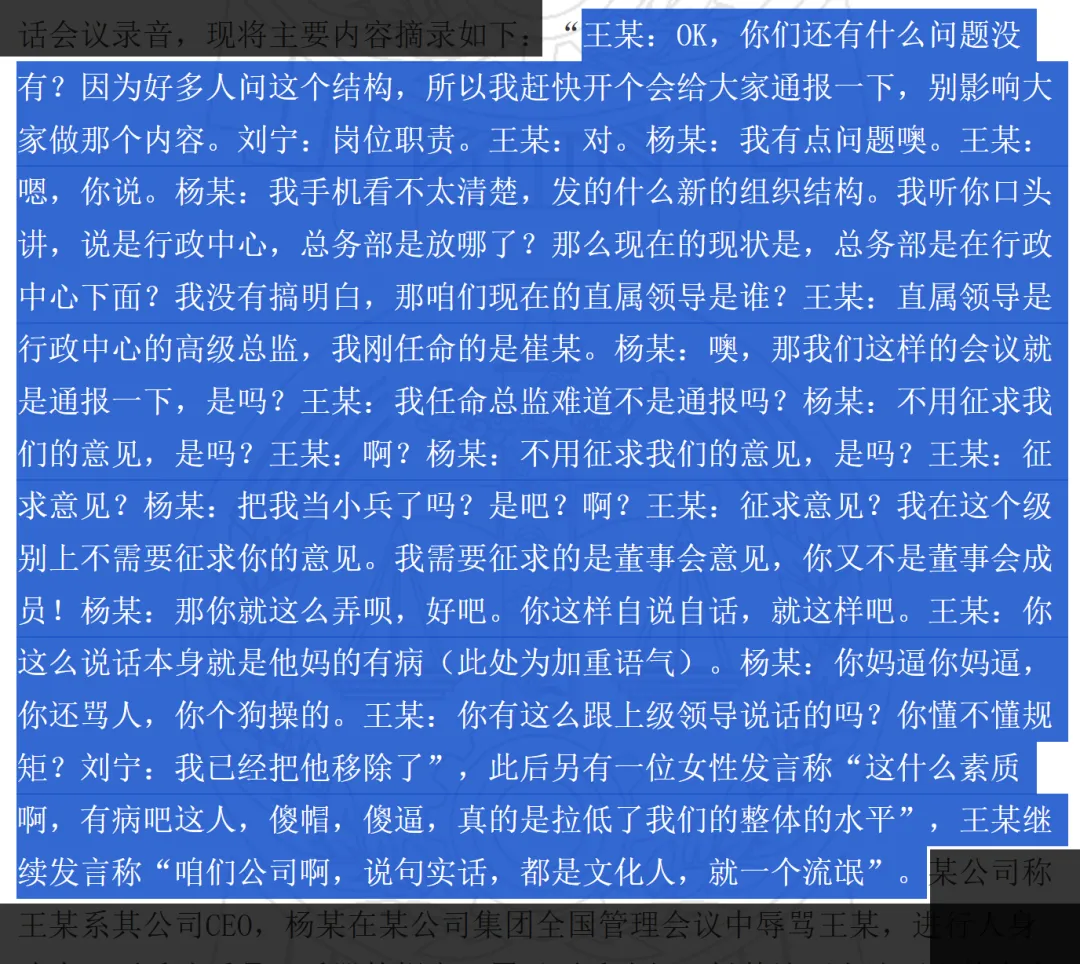
In simple terms, Yang and the CEO had a dispute over the selection of candidates for management positions. After the CEO used profanity, Yang launched into a fluent string of insults, cursing the CEO even more harshly.
However, the court held:
The company claimed that Yang, during a national meeting of campus management personnel, insulted and personally attacked the company’s CEO Wang, which constituted a serious disciplinary violation. However, on one hand, this incident was triggered by the company’s unilateral demotion of Yang without consensus, effectively changing the previously agreed-upon job position — the fault lay with the company. On the other hand, the recording showed that the company’s CEO Wang was the first to insult, after which Yang only then verbally retaliated. After Yang was removed from the meeting, Wang and others continued verbally attacking Yang, and the company only took action against Yang. Clearly, the company’s handling was inappropriate and constituted unlawful termination, and it shall pay Yang compensation for unlawful termination.
This means that although Yang cursed, the main cause was the company’s prior demotion, and Wang had insulted first (there was a reason for it). Although Yang cursed more harshly, the company’s other personnel and Wang also cursed a few more times after the fact, so the company was still in the wrong, and Yang did not constitute a “serious violation of company rules.”
Final judgment: The company shall pay Yang compensation for unlawful termination of labor contract in the amount of 843,480 yuan (eight hundred forty-three thousand four hundred eighty yuan) within ten days of the judgment taking effect.
This story teaches us:
1. Bosses are advised to reduce their habit of using foul language.
2. It is recommended to attack the issue, not the person.
III. Are There Cases Where the Company Won?
Yes.
For example: (2014) Pu Min Yi (Min) Chu Zi No. 29509
During department meetings on May 23, 2014, and May 30, 2014, Zong insulted his supervisor Wang to his face and threatened others’ personal safety. The company dismissed him for seriously violating the C-class faults (8) and (13) in the company’s employee handbook.
Zong argued that Wang was selling Amway products to him, and he had been repeatedly insulted by Wang for refusing to buy. On May 23 and May 30, 2014, Wang had insulted him first, and he only cursed back, so the company had no basis for termination.
After investigating both parties’ arguments and evidence, the court concluded:
This court finds that Zong first insulted his supervisor Wang on May 23, 2014, after which the two insulted each other, and Zong again insulted Wang on May 30, 2014. Although Zong claimed that Wang had been insulting him during meetings and that his cursing on May 23 was forced retaliation, the recorded conversation from May 23, 2014, shows that Zong insulted first, after which the two insulted each other… Therefore, Zong’s arguments lack a basis and are not adopted by this court. It should be noted that maintaining the employer’s production and operational order is a basic obligation of employees. Even if, as Zong claimed, Wang had insulted first on May 23, Zong should have adopted other rational methods to handle the situation.
In this case, the court found that Zong (the defendant) had repeatedly insulted his superior first, so it was reasonable to find that he had “seriously violated the Internal Rules.”
Furthermore, the court held that even if the supervisor had indeed insulted first, Zong should have handled it through rational means, so the company’s termination was reasonable.
Compared to the earlier case, quite interesting, isn’t it?
IV. Summary
How can you fire an employee who curses?
In short, the following conditions must be met:
-
The company must have a reasonable, formal set of Internal Rules that have been published and acknowledged, and the Rules must clearly state that “cursing constitutes a serious violation of company discipline” (pay attention to maintaining records of publication and acknowledgment — many companies trip up here);
-
The employee has repeatedly violated the Rules by cursing, or the cursing was particularly offensive, or occurred in clearly inappropriate settings (such as while receiving third parties), or other clearly public and improper conduct (cursing the boss in relatively private settings such as private chats, commutes, or dormitories is generally not considered a violation of work discipline);
-
The company did not “insult first” or “cause the employee to feel wronged first”;
-
The content of the cursing was directed at the person rather than the issue (e.g., the employee directly called the boss an idiot, rather than evaluating a specific decision).
And so on.
The core principle is:
It must be strongly work-related — occurring at the workplace (including off-site work locations), during working hours, and in the presence of other employees.
However, it is recommended that bosses also be “magnanimous.”
If you easily fire an employee using this reason just because they cursed a couple of times, it may constitute “unlawful termination.”
Letting the employee enjoy their cursing spree and then collecting 2N compensation would be a net loss.