Core Employee Questions Wearing Suits to Annual Meeting, Gets Fired the Same Afternoon?
Using the incident of a software company firing employees for questioning the suit requirement at the annual meeting as a starting point, this article analyzes the reasonableness of mandatory dress codes, standards for determining disciplinary violations, and compensation calculations for unlawful termination.
Recently, a screenshot of a chat interface showing “software company employees questioned wearing suits to the annual meeting and got fired” went viral online:
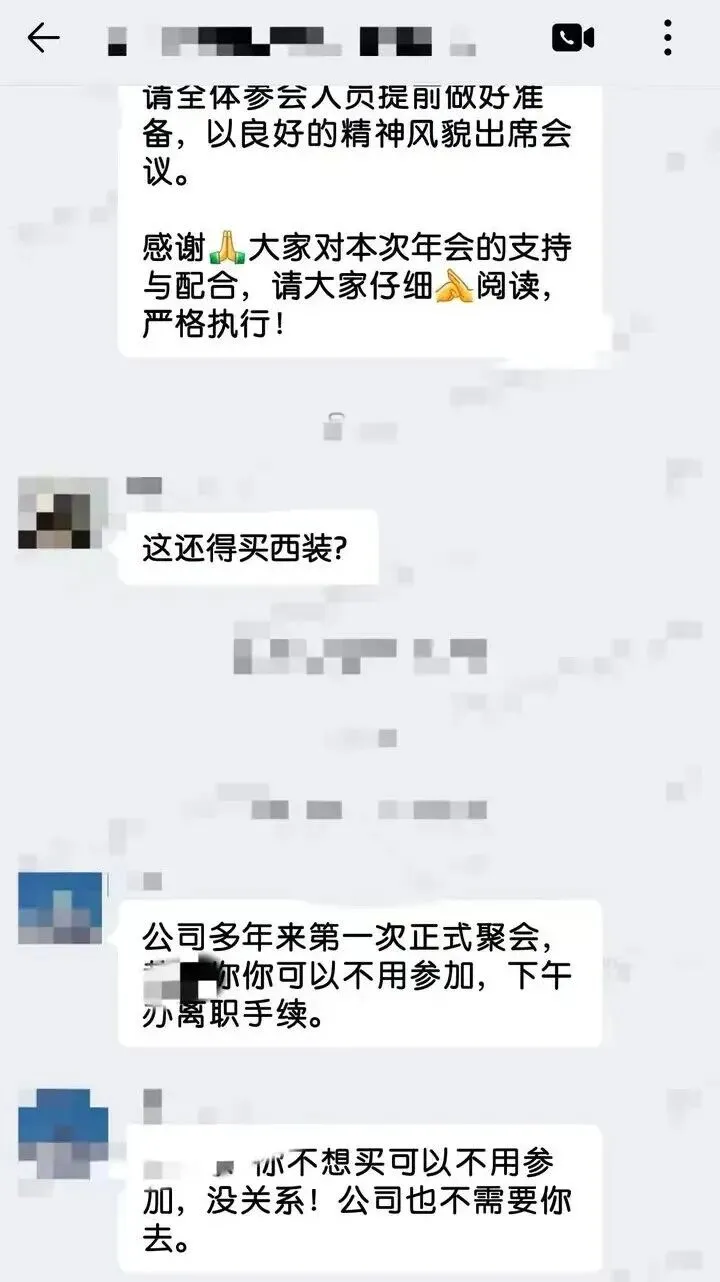
(Two employees were dismissed; one of them retracted their message, but it was still seen.)
The rumor goes that a software company required all employees to wear suits to the annual meeting on January 9, and two employees expressed disagreement.
Then the chairman personally @-mentioned them and handed them termination packages.
But netizens discovered that one of the terminated employees was no marginal figure — they were a core technical staff member responsible for “resolving kernel stability.”
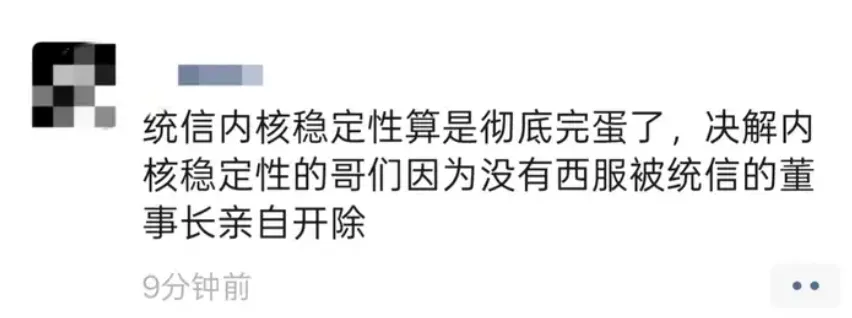
Quite surreal for the start of 2026.
So —
With year-end approaching,
Does not wearing a suit to the annual meeting count as “serious violation of discipline”?
If someone insists on not wearing one, can they be fired?
*This article represents the author’s personal views only and does not constitute legal advice or opinion.
1. Does Not Wearing a Suit to the Annual Meeting Count as “Serious Violation of Discipline”?
To answer this, let’s look at what the law says:
The boss can indeed require employees to wear suits
From a legal standpoint, the law grants employers the right to manage labor.
Pursuant to Article 4 of the Labor Contract Law, employers shall establish and improve labor rules and regulations in accordance with the law. To maintain corporate image or for occupational safety considerations, companies have the right to set dress codes.
Therefore, banks, flight attendants, retail staff, front desk receptionists — positions involving external business, customer-facing service, or simply roles “visible to the outside” — requiring formal attire is reasonable.
However, such requirements must be “reasonable.”
For pure back-end R&D roles, requiring them to purchase expensive clothing at their own expense for a single internal event — such reasonableness would be difficult to sustain in arbitration or litigation.
And is this written in the Employee Handbook?
An announcement in the HR group chat, or even a verbal “request” from company leadership, does not carry the same legal force as formal “rules and regulations.”
To find an employee in violation of discipline, there must be a basis in the company’s existing, lawful rules and regulations (typically embodied in the Employee Handbook, Personnel Management Manual, etc.).
A lawful disciplinary basis must satisfy three basic conditions: lawful content, democratic procedure, and public notification.
That is: the rules must not violate national laws and regulations, must be discussed by the employee representative congress or all employees, and must have been publicized or communicated to workers (such as signed acknowledgment, read receipt, etc.).
If the company’s Employee Handbook does not explicitly state that “not wearing a suit to the annual meeting constitutes serious violation of discipline,” then a temporary notice posted in a group chat by HR or leadership can hardly serve as a lawful basis for termination.
Furthermore, even if the handbook actually said “not wearing a suit to the annual meeting results in termination,” this provision would most likely be deemed invalid by judicial authorities due to lack of reasonableness (as discussed above).
Bonus: Is the Annual Meeting Actually Part of “Work”?
Year-end is here, and many companies are preparing for their annual meetings.
Meanwhile, various “annual meeting reminders” are constantly being circulated.
One very common rule might be: “Not attending the annual meeting means taking leave; not taking leave means absenteeism.”
But is this acceptable?
In judicial practice, the determination of annual meetings typically falls into two scenarios:
[On a Workday / During Working Hours]
If the annual meeting takes up normal working hours and the company does not require employees to “make up the time,” then it is generally considered an extension of work arrangements, and employees should in principle comply with the company’s management.
At the same time, since it takes up working time, an employee who does not attend the annual meeting is also “failing to provide labor.” In such cases, if an employee truly does not attend, they should apply for personal leave or annual leave per company procedures. If they neither apply for leave nor show up, the company has the right to treat it as “absenteeism” and deduct the day’s wages.
(Of course, this assumes the annual meeting isn’t suddenly announced to be held in Southeast Asia.)
[On a Rest Day / Outside Working Hours]
For annual meetings held on rest days without subsequent “compensatory time off,” it is difficult to classify them as overtime (since no specific work tasks are assigned that day). In this case, employees have the right to refuse attendance.
The company cannot require employees to take leave or deduct wages. If the company withholds pay for this reason, it constitutes illegal wage deduction.
Therefore, even if this company’s annual meeting was held on a workday — making attendance obligatory — the act of “not wearing a suit” is at most a failure to meet the event’s specific requirements, and can hardly even be considered a minor disciplinary violation.
Labeling it directly as “serious violation of discipline” and using it as grounds for termination represents a break in legal logic and constitutes a typical case of unlawful termination.
2. “Process Departure This Afternoon”: Termination or Persuasion to Resign?
The phrase “process your departure this afternoon” in the screenshot may be seen by many as “termination,” but depending on the actual procedure, the outcome could differ.
Beware of “Voluntary Resignation” Under Pressure
Legally, “termination” (unilateral dismissal by the company) and “resignation” (voluntary departure by the employee) have vastly different consequences.
When a senior executive vents in a group chat, it counts as an emotional expression or oral notice. If employees, out of fear or anger, obediently go to HR in the afternoon to fill out a “Resignation Application Form,” and under HR’s “persuasion” tick the box for “personal reasons” or “family reasons,” then legally, this would most likely be deemed voluntary resignation.
Once deemed voluntary resignation, the company is in principle not required to pay any economic compensation.
If the matter later goes to labor arbitration or court, although the “termination screenshot” has some evidentiary value, it becomes troublesome to explain when faced with questions like “HR didn’t even contact you — why did you voluntarily submit a resignation application and check ‘personal reasons’?”
What Should Employees Do?
When facing this situation, there is one core principle: stay calm and do not voluntarily apply for resignation.
As long as you have not received a formal written termination notice bearing the company’s official seal, you should clock in and work normally. Avoid giving the company an excuse to lawfully fire you for “consecutive absenteeism” (which would mean zero compensation).
If HR or a supervisor verbally tells you to leave, explicitly request a written “Notice of Termination of Labor Contract.” Once you receive the written notice, carefully review the stated reason for termination. If it says “serious violation of discipline” without specific grounds, insist they specify — this will serve as crucial evidence for subsequent arbitration or litigation.
Also, before being removed from group chats, save chat records (screenshots), recordings, email correspondence, and attendance records, to prevent the company from tampering with backend data or you losing access.
Bonus 2: The Difference Between “N” and “2N”
Since we’re discussing compensation, let’s talk about what “N” and “2N” actually mean.
Whether you get “N” or “2N” depends on whether the company’s “firing” is lawful.
【N (Economic Compensation)】
Economic compensation applies to lawful termination that still requires payment. For example: company layoffs, non-renewal of fixed-term contracts, employee incompetence after training, or mutually agreed termination (initiated by the company).
In these cases, the company is acting lawfully but must still compensate the employee.
Labor Contract Law of the People’s Republic of China:
Article 46: Under any of the following circumstances, the employer shall pay economic compensation to the employee:
(1) The employee terminates the labor contract in accordance with Article 38 of this Law;
(2) The employer proposes termination of the labor contract in accordance with Article 36 of this Law and reaches a consensus with the employee;
(3) The employer terminates the labor contract in accordance with Article 40 of this Law;
(4) The employer terminates the labor contract in accordance with paragraph 1 of Article 41 of this Law;
(5) The employer terminates a fixed-term labor contract in accordance with item (1) of Article 44 of this Law, unless the employer maintains or improves the conditions for renewal and the employee does not agree to renew;
(6) Termination of the labor contract in accordance with items (4) and (5) of Article 44 of this Law;
(7) Other circumstances provided by laws and administrative regulations.
【2N (Damages)】
Damages apply to unlawful termination. For example: the company fires an employee without just cause, the stated reason is invalid (as in this case where questioning the suit requirement was deemed “serious violation of discipline”), or the termination procedure is unlawful.
This is the law’s punishment for illegal employer conduct.
Labor Contract Law of the People’s Republic of China:
Article 87: If an employer violates the provisions of this Law by terminating or ending a labor contract, it shall pay damages equal to twice the economic compensation standard specified in Article 47 of this Law.
【How to Calculate “N”】
So how is N calculated?
According to Article 47 of the Labor Contract Law: one month’s wages for each full year of service; six months or more but less than one year counts as one year (one month’s wages); less than six months counts as half a month’s wages.
For example: 1 year 7 months of service, N=2; 1 year 3 months of service, N=1.5.
If the employee’s average monthly wage exceeds 3 times the local average social wage, the calculation caps at 3 times, and the payment period is capped at 12 years.
In practice, many regions in China have implemented a “dual cap,” which also applies to damages:
N <= average social wage x 3 x 12
2N <= average social wage x 3 x 2 x 12 (note: not 24, and not actual years of service)
Labor Contract Law of the People’s Republic of China:
Article 47: Economic compensation shall be paid based on the number of years the employee has worked for the employer, at the rate of one month’s wages for each full year. Six months or more but less than one year shall be counted as one year; less than six months shall be paid half a month’s wages.
If the employee’s monthly wage exceeds three times the average monthly wage of the previous year in the region published by the municipal government of the city where the employer is located, the standard for economic compensation shall be three times the average monthly wage, and the maximum number of years for which economic compensation is paid shall not exceed twelve years.
The “monthly wage” in this Article refers to the employee’s average monthly wage for the twelve months prior to the termination or ending of the labor contract.
3. Even If Suits Are Required, Do Employees Have to Pay for Themselves?
The trigger for this incident — one employee’s comments are unknown, but another employee’s objection to “buying a suit at their own expense” is quite interesting.
Who Should Bear the Cost of Work Uniforms?
Although the Labor Law does not explicitly state who must pay for work uniforms, judicial practice generally follows this principle:
Costs arising from work requirements shall be borne by the employer.
Work uniforms are essentially clothing that companies require employees to wear for production safety, uniform image, or management needs. They form part of labor protection equipment or the company’s operational management costs.
In the spirit of the law, shifting such operational costs onto employees is unreasonable.
Therefore, in practice — whether for safety-protection workwear or service uniforms for image consistency — the vast majority of reputable companies provide uniforms free of charge or offer purchase subsidies.
Note: If the company clearly designates these as “work uniforms” and bears all or most of the cost, ownership is typically stipulated in company rules as belonging to the company. When an employee leaves, the company has the right to reclaim them or buy them back at a discount.
Are Employees Obligated to Pay for Annual Meeting Attire?
In this incident, what needed to be worn to the annual meeting was certainly not a work uniform.
Annual meeting attire — especially for non-business roles like programmers — is not part of daily work requirements. Suits are needed only to satisfy the company’s one-time, temporary event requirements.
The employee’s labor obligation is to provide labor and comply with lawful rules and regulations. The company’s temporary dress code “suggestion,” particularly when employees are expected to pay out of pocket, does not constitute a binding “labor obligation.”
An employee’s refusal to purchase at their own expense does not amount to “failure to provide labor” or “disciplinary violation.” If the company terminates the contract on this basis, it would very likely be deemed unlawful termination.
Bonus 3: If a Purchased/Rented Suit Gets Dirty at the Annual Meeting, Who Pays?
Suppose an employee buys or rents an expensive outfit (“feathers and all”) to comply with the company’s request, but it gets accidentally stained or damaged during the event (a colleague toasting, game segments, etc.).
Who compensates?
If a colleague accidentally soils it, then under the Civil Code, the tortfeasor (that colleague) should bear liability for compensation.
If it’s damaged during a chaotic game segment and no specific person is identifiable, the situation becomes more complicated. In this case, the employee can claim compensation from the company.
As the event organizer and manager, the company has a safety protection obligation. If the company’s designed event activities involve risks (crowding, roughhousing) and it fails to exercise adequate management and protection — leading to employee property damage — it will very likely be held to bear supplementary compensation liability.
Of course, the employee also needs to prove they exercised reasonable care. (Please don’t deliberately bring an expensive outfit to the annual meeting, get it damaged, and then try to claim from the company.)
4. Final Thoughts
This operating system company is a member of the “Xinchuang” (domestic innovation) initiative — essentially part of the national team. What is its true core competitiveness?
Perhaps it’s the quality of millions of lines of code, the stability of the system, or core technical talents like the employee who was “persuaded to leave” — someone capable of resolving kernel-leveldifficult and complex problems.
It’s certainly not whether everyone looks “elite” at the annual meeting.
After all, “the system must be stable.”
Of course, “gold always shines.” Every time one of these “termination scandals” breaks, HR teams and headhunters are the first to catch wind:
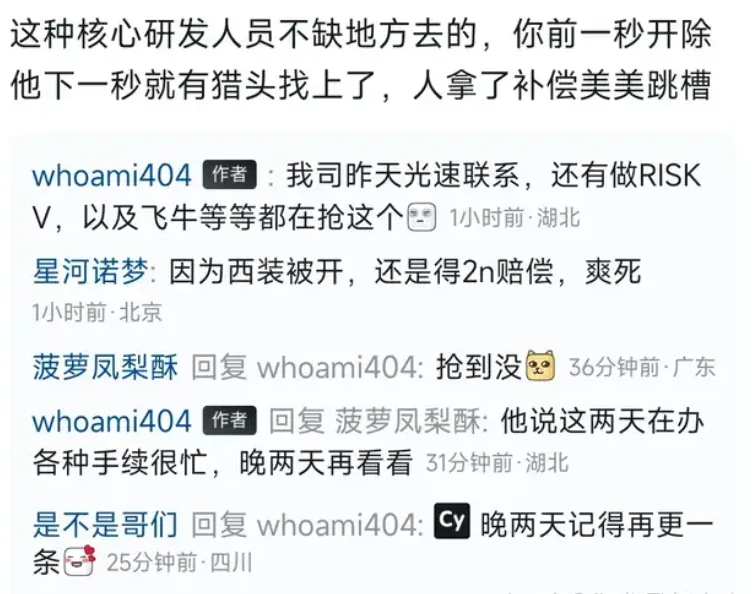
After all, talent capable of fixing operating system kernels is far rarer than talent capable of wearing suits.
Let’s hope this system doesn’t have any major bugs in the near future.
Netizens do love being “spectators.”