Received a 'Social Insurance Back Payment' SMS from the Tax Bureau? How Should Employers and Employees Respond?
With big data on income tax and social insurance now in full effect, the traditional practice of 'paying social insurance at the minimum base rate' is no longer viable. This article analyzes social insurance contribution base calculation rules, whether employers can deduct back payments from salaries, and whether employees can file labor arbitration claims.
Recently, quite a few company owners and financial controllers
picked up their phones, glanced at the screen, and their faces turned pale

The message was short, but its implications were enormous
It could truly be a case of
“every word worth a thousand gold”
Big data for “income tax + social insurance” has officially kicked into gear
And it may soon be fully integrated with AI
The traditional practice of “paying social insurance at the minimum base rate”
has officially been declared dead
So
What does receiving this notice actually mean? How should the compliant contribution base be calculated? If back payment is needed, can the company directly deduct it from the employee’s current salary? If deducted, can the employee file a labor arbitration claim?
*This article represents only the author’s personal views and does not constitute legal advice for specific cases.
I. “Minimum Wage Social Insurance” No Longer Works?
Many startups or small-to-medium companies
whether to control labor costs
or to meet employees’ needs of “earning this money and going back home”
often reach an unspoken “understanding” with employees:
The contract is written at the local minimum wage
The remaining salary is paid under other categories
And then naturally
social insurance and housing fund contributions are paid at the local minimum wage standard
Everyone gets more cash in hand, and the company’s costs decrease
A true “win-win”
Previously, social insurance and tax data weren’t fully integrated
This practice did have some room for侥幸
But since “social insurance into tax” (unified collection of social insurance premiums by tax authorities) was fully implemented
Along with the continuous upgrading of the Golden Tax system
The hand of “big data” has officially reached into the “social insurance” domain
The tax bureau’s big data comparison logic is very simple and direct, but extremely efficient:
It directly pulls the company’s declared “personal income tax” revenue data
Then compares it with the company’s declared “social insurance contribution base”
If a lead programmer declares a monthly salary of 25,000 yuan for tax purposes
But the social insurance contribution base is only 2,500 yuan
With a tenfold discrepancy
Anyone can see there’s a problem
An alert is triggered immediately
II. How Should the Social Insurance Contribution Base Be Calculated? Is Everyone Actually Breaking the Law?
According to compliance standards, how should the social insurance contribution base be determined?
Most companies might think “just calculate based on monthly salary”
If there’s a salary increase at year end, just remember to update it in next year’s window period
But is that really correct?
”Notice on Issues Related to Standardizing Social Insurance Contribution Bases” (Labor and Social Insurance Center Letter [2006] No. 60)
In 1990, the National Bureau of Statistics issued “Provisions on the Composition of Total Wages” (National Bureau of Statistics Order No. 1), which defined the components of wages
These “Provisions” haven’t been revised since the per capita disposable income was 900 yuan, to the current 43,377 yuan
However, from top to bottom, every so often, each locality has issued numerous documents regarding wages and social insurance bases
Ultimately, the above “Notice” essentially settled the matter as the “final interpretation” for national social insurance bases
In simple terms, the social insurance contribution base includes the following:
Wages
Wages are easy to understand
Hourly wages, piece-rate wages, position wages, performance wages…
Regardless of the category, just add up the total amounts in the labor contract and supplementary agreements
But besides the regular wages mentioned above
Overtime pay should also be included
Whether it’s called “overtime pay” or “diligence bonus”
As long as it’s income earned from overtime, it should be counted in the social insurance base
Bonuses
Everyone knows wages should be included in social insurance
But “bonuses” should also be included
“Year-end bonuses” should be included, “sales commission bonuses” should be included, “model worker awards” should be included…
Strictly speaking, there are many categories people might not think of that should also be included
Such as “perfect attendance awards,” “savings bonuses”…
Even bonuses from internal company competitions for first, second, and third place
As long as it’s a company “reward” to an individual (cash counts directly, goods are converted)
Everything should be included
Allowances and Subsidies
Government employees have different allowance and subsidy content
We won’t elaborate here
But private companies actually have some too
For example, “high temperature allowances” should naturally be included in the base
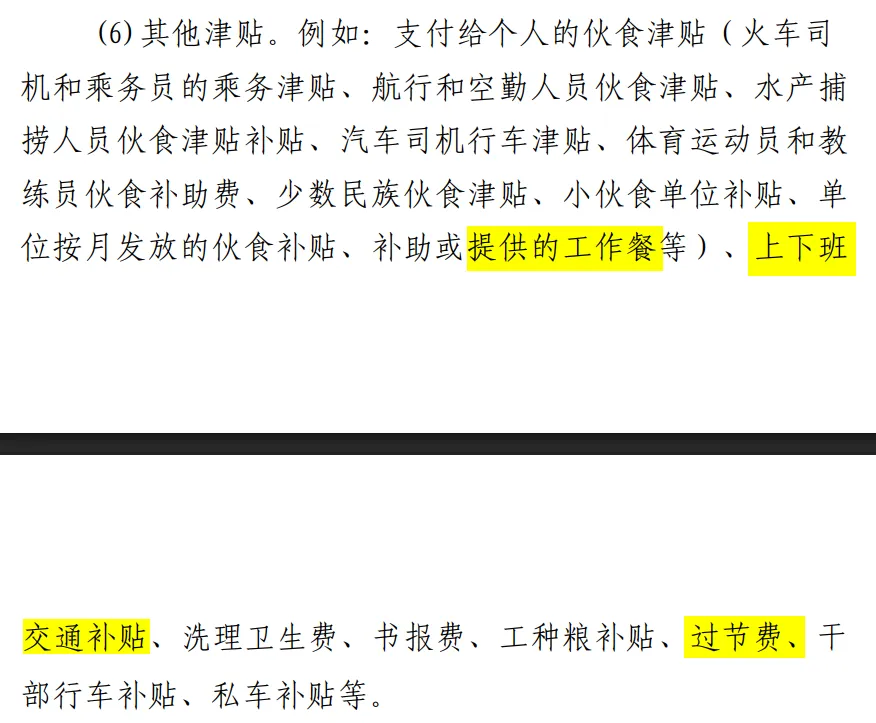
But did you know that in the “Notice”
“Meal subsidies” (work meals) are also part of what should be included?
Even “taxi fees,” “holiday gifts,” and so on
The Simplest Method: Use the Previous Year’s Personal Monthly Average Wage as the Contribution Base
At this point, do you feel overwhelmed by all these categories and can’t figure out how to calculate?
The authorities thought the same thing
Considering there are too many miscellaneous categories
The “Notice” helpfully provides a “quick calculation” method
Which is to directly use “the previous year’s personal monthly average wage” to fill in this year’s social insurance base
After social insurance and income tax are integrated, the tax bureau doesn’t even need to come on-site to investigate item by item
It can directly require companies to calculate based on employees
(last year’s total declared income tax wages + bonuses) / 12
to declare this year’s social insurance
Simple and straightforward
Thought: What About People Who Rely on “Year-End Dividends”?
But this method has a rather serious practical problem
Some industries may have “good years and bad years”
Some positions may have a “low base salary + high dividends” structure
Let’s take game industry workers as the simplest example
How many project team members work with relatively modest base salaries, working overtime every day, just hoping the game will “blow up” when launched, so they can get a huge project bonus at year end to pay a down payment
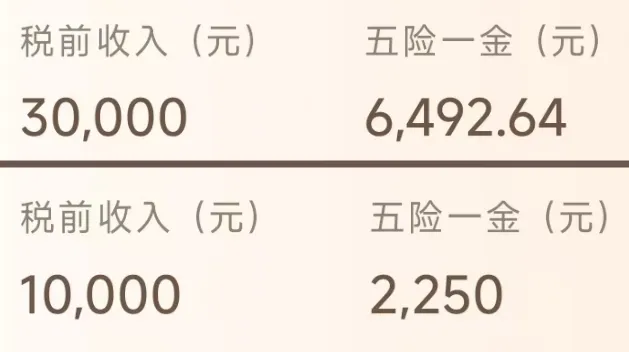
Suppose last year the game was a huge hit, and the lead designer received 1 million yuan in bonuses, averaging out to a monthly income of 100,000 yuan last year
According to the tax bureau’s calculation, this year’s social insurance base would be directly maxed out at the local maximum cap (for example, in Guangzhou, depending on the tax type, it’s about 30,000 yuan)
“No problem, the game is just starting to expand, next year will definitely be better, let’s pay the down payment first”
The next year, the game “flops”
The project team is even on the verge of being dissolved, and the lead designer can only survive on a basic salary without performance bonuses
Now the lead designer faces a monthly salary of about 10,000 yuan, or even less than 10,000 yuan, but has to pay social insurance based on a 30,000 yuan contribution base
When payday arrives
Looking at the huge social insurance deduction on the pay slip, then checking the meager balance left in the bank account
Is this punishment for earning too much last year, or being exploited for struggling this year?
III. If Back Payment Is Needed, Can the Company Directly “Deduct” from Employee Wages?
How to make the back payment won’t be discussed here
Just follow the official guidance directly
But another question arises:
Social insurance is divided into “company contribution” and “individual contribution”
Since underpayments were made in the past, and now need to be paid based on the true base
The employee’s individual underpaid portion naturally also needs to be made up
The company’s own portion is straightforward, just pay it back
But getting money that’s already in the employee’s pocket back out is not easy
At this point, HR might think:
“Since it’s money the employee should have paid, just deduct it from next month’s salary and remit it to the tax bureau, right?”
It’s not that simple
Employees do have an obligation to bear their individual portion of social insurance back payments. In fact, according to the “Interim Provisions on Wage Payment” and other laws and regulations, employers can legitimately deduct from employee wages under the pretext of “withholding and remitting employee social insurance” without it constituting a violation
But how much can be deducted at most?
After deduction, can it go below the local minimum wage standard?
Unfortunately
There is currently no extremely clear and nationally unified legal regulation
According to the definition in the “Minimum Wage Provisions”:
Under the condition that the employee provides normal labor, the wages that the employer should pay to the employee, after deducting the following items, shall not be lower than the local minimum wage standard: (i) Wages for extended working hours; (ii) Allowances for special working conditions such as middle shift, night shift, high temperature, low temperature, underground, toxic or harmful work environments; (iii) Welfare benefits stipulated by laws, regulations, and the state.
But social insurance essentially falls under “obligations” rather than “welfare benefits,” so different localities have their own interpretations
Different regions have different regulations on whether the minimum wage includes the employee’s personal “five insurances and one fund” contributions
Even Beijing, Shanghai, Guangzhou, and Shenzhen differ
Guangzhou, Shenzhen, and similar places tend to believe the minimum wage standard already includes the employee’s personal share of “five insurances and one fund” (at least there’s no explicit denial)
While in Beijing and Shanghai, the minimum wage standard does not include “five insurances and one fund,” meaning the “net take-home pay” must always be higher than the local minimum wage regardless of deductions
In any case, in most regions, as long as the deducted take-home pay is above the minimum wage standard, it may satisfy the basic “compliance requirement”
Of course, this is quite inhumane
So a more compassionate approach that can also avoid escalating labor-management conflicts would be:
The company first advances the full back payment amount
Then negotiate with the employee and sign a written “installment deduction agreement”
While meeting the employee’s basic living needs, gradually deduct over several months from wages
If the employee resigns during this period, then require them to settle the remaining advance payment in full
Imagine the lead designer mentioned earlier who experienced the “ups and downs” of the game
This year is already struggling under the double blow of “drastically reduced base salary + last year’s ultra-high social insurance base”
If at this point the company also wants to deduct a large back payment from the already meager monthly salary for last year’s social insurance
The scene on payday would be truly unimaginable
And this is just for current employees, who can at least have gradual deductions from their wages
As for how to chase down former employees who have already left and get them to pay up for back payments?
That’s probably the real nightmare keeping HR and bosses up at night
IV. Can Employees File Labor Arbitration Because of Back Payments?
Once social insurance back payments are involved, causing employees’ take-home pay to decrease
Or even as mentioned earlier, not only having current month’s social insurance deducted at a high base, but also having past underpayments deducted from wages
Many employees’ first reaction would absolutely be:
“The company violated the law first! How dare they deduct my money? I’m going to file for arbitration! I’m going to report to the labor inspectorate!”

But it may not necessarily be accepted
”I want to file arbitration/labor inspectorate complaint, the company itself violated the law and is deducting my wages!”
Holding the pay slip and the company’s “Back Payment Notice”
Storming into the labor inspection team or arbitration committee shouting: “The company is arbitrarily deducting my wages!”
You’ll likely just hit a “closed door”
A common misconception is: According to the law, the company has withholding and remittance obligations, underpaying social insurance is the company’s fault, so all back payments should be borne by the company
But legally, social insurance is divided into “company pooled funds” and “individual accounts”
In the past, when paying at a low base, the company certainly underpaid the pooled portion, but the employee also underpaid their individual portion (and received more money)
Now when making legal back payments, the company pays its part, and the employee pays their own
The company, as the “withholding agent” under the Social Insurance Law, deducting the “individual’s due portion” from the employee’s current wages is fulfilling a legal obligation, not “wage deduction” in the sense of the Labor Law
So, trying to defend rights based on “company violated the law and is making arbitrary deductions for back payments”?
It’s basically very difficult to succeed
”The company didn’t pay full social insurance, I want to resign involuntarily and claim N times economic compensation!”
Since the deduction can’t be reversed, some legally-savvy friends might think of Article 38 of the Labor Contract Law
Directly using the employer’s “failure to pay social insurance premiums for the employee in accordance with the law” as grounds to unilaterally terminate the labor contract and claim economic compensation (commonly known as involuntary resignation for N)
However, in practice, in many regions’ judicial practice
The “failure to comply with the law” here is usually strictly interpreted
Generally, it only supports cases where “no social insurance account was established at all”
At most, it recognizes “incomplete insurance types” (e.g., only work injury was paid, not pension)
If the company has been normally paying all five insurances for you, and it’s merely that “the base was calculated too low”
And this “low” was even with your own acknowledgment
Sending a “Notice of Involuntary Resignation” demanding N compensation on these grounds
In the vast majority of cases, arbitration and courts will absolutely not support it
The consequence of impulsively sending such notice might be: Not only failing to get the N compensation, but also being recognized as “employee voluntarily resigned for personal reasons,” unable to even claim unemployment benefits
A total loss
”The company deducted my monthly salary to negative for social insurance back payments!”
After reading the first two points, do you feel employees can only swallow this bitter pill?
Not entirely, disputes often arise on the “path of least resistance”
Only in one situation would an employee have a very high probability of winning a labor arbitration case:
HR was too lazy to do installments and made a “one-time deduction,” making the employee’s monthly salary negative, or deducted it below the local minimum wage standard (refer to the differences across regions in the previous section)
If this happens, the employee’s arbitration case changes
It’s no longer the thankless “social insurance dispute”
But becomes a real case of “malicious wage deduction”
In the field of labor law, protecting employees’ “basic right to subsistence (minimum wage)” takes priority over “cooperating with administrative departments for social insurance back payments” (even when a company files for bankruptcy, wages must be paid first)
Once a brutal deduction is recognized as wage deduction
When the employee then claims involuntary resignation and demands N times economic compensation, the winning rate skyrockets
V. Finally
“Social insurance back payments” are happening nationwide
Since the SMS has already arrived on your phone
Better to endure short-term pain than prolong it
Just make the payment
But a small tip
Before paying, it’s best to call and ask how much the individual portion is
In the era of big data + AI
The era of wild growth and its dividends is gradually closing
Refined, compliant operations are the premise for survival and long-term development
Compliance may bring temporary pain
But at least it lets everyone sleep well at night