The 'Publishing Management Regulations' Have Been Revised — Are Penalties Stricter? | With Analysis on Deductible Costs from 'Illegal Income'
The 2024 amendments to China's Publishing Management Regulations raise minimum fines and introduce 'illegal income' as the penalty basis, with game companies facing stricter rules on which costs are deductible.
On December 13, 2024, the State Council issued this year’s “Decision of the State Council on Amending and Repealing Certain Administrative Regulations (State Council Order No. 797),” amending certain provisions of 21 administrative regulations and repealing 4 administrative regulations, effective January 20, 2025.
Among the 21 amended regulations, the one most closely related to the gaming industry is the “Publishing Management Regulations.”
What exactly has been amended? Are the rules stricter or looser?
This article will provide a brief analysis.
This article represents only the author’s personal views and does not constitute legal advice or legal opinion.
I. Overview of Amendments to the Publishing Management Regulations
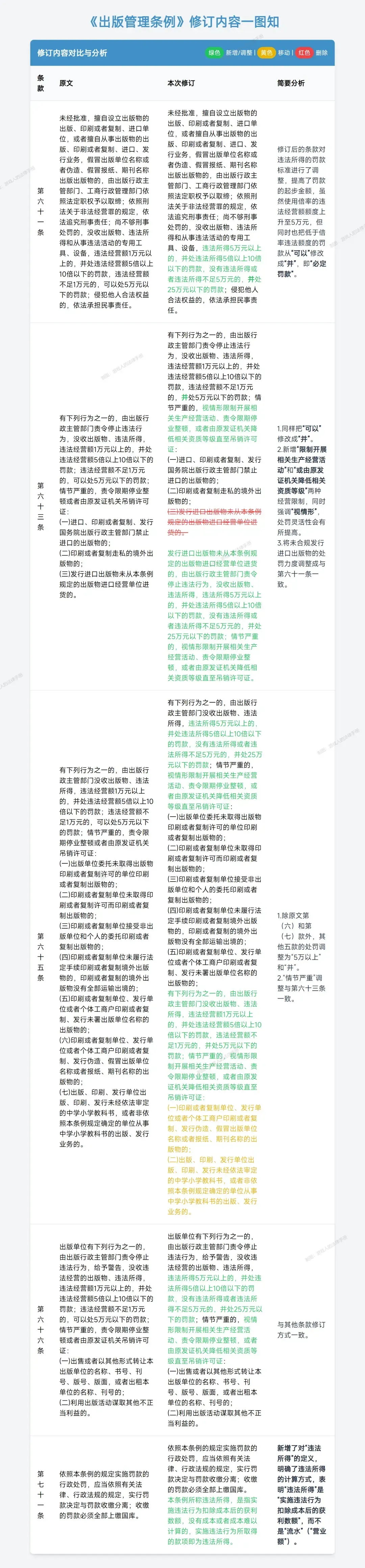
II. Brief Explanation
Among the amendments in this revision, Article 61 is the most relevant to game companies. The core changes can be summarized in two points:
1. Adjustment of Penalty Standards
The minimum fine based on multiples was raised from the original 10,000 yuan to 50,000 yuan. When the illegal income is less than 50,000 yuan, the maximum fine has been increased to 250,000 yuan, and a “mandatory fine” is now explicitly stipulated. At first glance, this might seem like a relaxation of the minimum threshold for multiple-based fines. However, in practice, the original “discretionary power” has been reduced and replaced by a “combined penalty” policy, making penalties for violations more明确 and achieving a “must be punished for every violation” effect.
2. Introduction of the Term “Illegal Income”
This amendment introduces the term “illegal income,” changing some provisions from the original “illegal business turnover” to “illegal income.” This change in terminology is not unprecedented. In the Criminal Law Amendment (XI), many intellectual property crimes had their sentencing standards adjusted from “sales amount” to “amount of illegal income.”
Although this may superficially appear to provide more room for reduction in the认定 of illegal amounts, in practice, the deduction of costs from “illegal income” requires consideration of various factors and therefore is not simply equivalent to “calculating only net profit.”
A brief explanation follows:
III. Brief Analysis of Deductions from “Illegal Income”
Since the amendment in the “Criminal Law Amendment (XI),” the specific meaning and boundaries of “illegal income” have sparked extensive discussion in the legal community. However, there is a general consensus: “illegal income” does not mean that violators can arbitrarily deduct all costs.
In practice, judicial authorities will specifically analyze which costs are deductible and which are not. For example, some costs closely related to the illegal act may be deemed “costs of the crime” and not deductible.
Although the “Publishing Management Regulations” are administrative regulations, they can also refer to standards from other laws and regulations. In particular, “illegal publishing” activities, when severe, can escalate to the crime of “illegal business operation.” Additionally, reference can be made to the relevant provisions of the “Measures for Determining Illegal Income in Administrative Penalties by the Industrial and Commercial Administrative Authorities,” which states: “Illegal income is the total revenue obtained by the party from the illegal production and sale of goods or provision of services, minus the appropriate and reasonable expenses directly used for the business activities.”
In the traditional publishing industry, deductible costs could include “printing paper, ink, etc.,” calculated as “the total sales revenue from illegally produced goods minus the purchase cost of raw materials used in production.”
However, the gaming industry differs significantly from traditional publishing. In my view, deductible and non-deductible costs for the gaming industry may be based on the following considerations:
Deductible Costs
1. Reasonable Expenses Directly Used for Business Activities
For example, costs incurred in the game production process for servers, production software, IP, legitimate art materials, etc., paid to external enterprises, can be deducted.
2. Tax Payments
Taxes and fees already paid in accordance with laws, regulations, and provisions of provincial-level or higher governments during game operation can be deducted.
Non-Deductible Costs
1. Internal Company Expenses for Game Production
This includes personnel costs, rent, fixed asset depreciation, loan interest, broadband fees, property management fees, utilities, and other expenses arising from activities surrounding the illegal acts — none of these are deductible.
2. Advertising (User Acquisition) Costs
Various advertising fees, user acquisition costs, and marketing expenses paid to promote the game are not deductible.
3. Expected Costs Not Actually Incurred
Only costs that have actually been incurred can be deducted. Various expected and non-incurred costs (such as IP fees paid in installments, etc.) are not deductible.
How to Distinguish?
Regarding which “business activity expenses” are deductible, I believe the distinction can be based on “whether there are other social benefits” and “whether they constitute illegal income.”
For external procurement costs, there are typically positive social benefits. For example, when a game company purchases servers, production software, legitimate art materials, etc., these are normal commercial transactions with external enterprises. The goods and services provided by external enterprises do not inherently have an illegal purpose. Therefore, such expenses not only align with business logic but also bring positive benefits to society and should be considered deductible costs.
However, internal costs present a different picture. These expenses are typically directly used for producing illegal game products and fall under the category of “costs of the violation.” Especially advertising and marketing expenses, which aim to obtain more illegal income rather than promote the company’s legitimate business development, not only have no social benefit but are also closely related to the illegal act and should not be deducted.
Furthermore, although employee salaries are unavoidable expenses in normal business operations, based on the principle that “illegal acts must not yield profit,” any individual or enterprise involved in illegal acts should not obtain economic benefits from them. Therefore, employee salaries are also considered part of “illegal income” and should not be deducted.
IV. Recommendations for Game Companies
1. Do Not Engage in Illegal Publishing
The simplest and most core compliance advice is to avoid any illegal publishing activities. As long as you do not cross this red line, you can fundamentally circumvent relevant legal risks.
2. Maintain Proper Accounting Records
This amendment explicitly states that if “costs are difficult to calculate,” the “amount received (total amount)” will be used as the basis for calculating the illegal amount.
Accounting books are one of the key pieces of evidence recognized by law.
Once accounting books are found to contain recording errors, false records, or other irregularities, judicial authorities may directly calculate the illegal income based on “total turnover,” causing the company to face more severe fines.
Therefore, ensuring the accuracy, standardization, and completeness of accounting books is an important part of compliance risk avoidance.
V. Conclusion
This revision of the “Publishing Management Regulations” did not touch upon much core content. There is still no specific definition of “illegal publishing” for the gaming industry.
Considering previous penalty cases involving amounts exceeding 100 million yuan, I recommend everyone persist in compliant operations and avoid any improper promotion or operational behavior that could lead to “illegal publishing.”